Showing posts with label History. Show all posts
Thursday
Tuesday
HISTORY: Titanic News Paper [1912]
Posted by
ա!Ⓛⓛ !ʍƥŐṥʂ!βⓁǝ
Introduction
Just a few words about the present exhibit. Serious scholarly effort is not represented here, but rather an attempt to highlight the potential of newspapers as sources for historical and cultural research.
Why an exhibit about the Titanic? Its a great human story, with cultural significance, enduring appeal, old and new controversy, and very well covered in newspapers.
These images represent first and foremost a story. The Titanic sank on April 14, 1912, off the coast of Newfoundland. The story is full of the pathos of 1500+ casualties, the heroism and/or cowardice among the passengers and crew; the very real questions relating to cause and effect; and the continuing aftermath.
But the sinking of the Titanic is more than an isolated historical event. She was the product of early 20th century industrial vigor, a concrete sign of western progress which supported a naive confidence in the boundless limits of technology in man's conquest over nature. The disaster has been interpreted as a metaphor for the failure of industrial civilization to build itself into a better unsinkable tomorrow!
The images themselves represent a sort of social history, 1912 caught in the amber of newsprint. In this context it is not just a question of what is covered--society, fashion, world events--but how the news is conveyed, these images reveal a past era's norms of public expression.
Lastly, there is the simple issue of preservation. Newsprint is a fragile and transitory but invaluable resource for this sort of factual and cultural information. This exhibit will underscore the potential of newspapers for research and the challenge they may present to students and researchers. To this end no heroic efforts have been made to produce the best images possible, but to produce a serviceable image from microfilm. Many newspapers exist on poorly produced or maintained film, researchers and students face this problem everyday!. The images reproduced here illustrate the need to preserve our heritage in a stable and durable medium which maintains content as well as format.
Wednesday
HISTORY: Beautiful Old Bikes
Posted by
ա!Ⓛⓛ !ʍƥŐṥʂ!βⓁǝ
[Right click on images 'open new window' to enlarge]
History
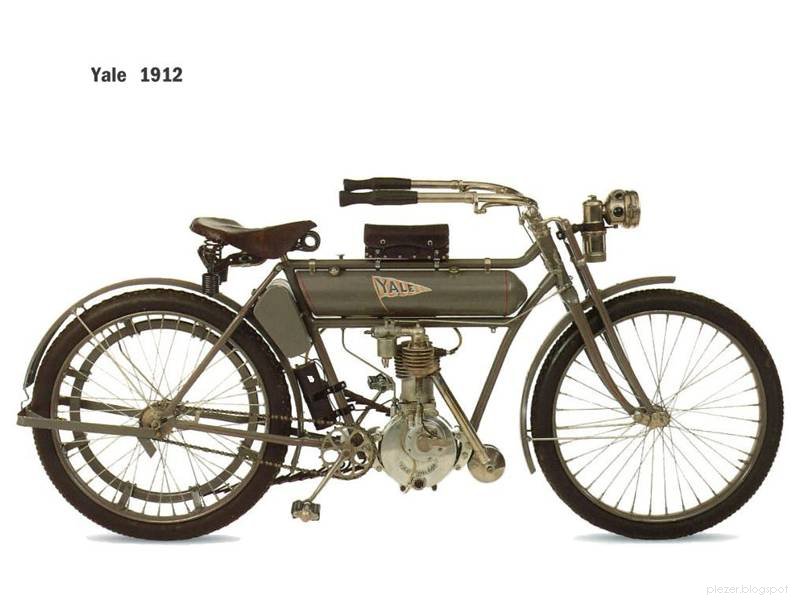
The inspiration for the earliest dirt bike, and arguably the first motorcycle, was designed and built by the German inventors Gottlieb Daimler and Wilhelm Maybach in Bad Cannstatt (since 1905 a city district of Stuttgart) in 1885. The first petroleum-powered vehicle, it was essentially a motorized bicycle, although the inventors called their invention the Reitwagen ("riding car"). They had not set out to create a vehicle form but to build a simple carriage for the engine, which was the focus of their endeavours.
However, if one counts two wheels with steam propulsion as being a motorcycle, then the first one may have been American. One such machine was demonstrated at fairs and circuses in the eastern US in 1867, built by Sylvester Howard Roper of Roxbury, Massachusetts. There is an existing example of a Roper machine dated 1869. But there is no patent existing and nothing proves it was working. It's powered by a charcoal-fired two-cylinder engine, whose connecting rods directly drive a crank on the rear wheel. This machine predates the invention of the safety bicycle by many years, so its chassis is also based on the "boneshaker" bike. In 1868, the French engineer Louis-Guillaume Perreaux patented a similar steam-powered motorcycle, probably invented independent of Roper. In his case a patent exists (dated 1868), but nothing indicates his invention had moved before 1871. In 1894, the Hildebrand & Wolfmüller became the first motorcycle available for purchase.
In the early period of motorcycle history there were many manufacturers as producers of bicycles adapted their designs for the new internal combustion engine. As the engines became more powerful and designs outgrew the bicycle origins, the number of motorcycle producers increased.
Until the First World War, the largest motorcycle manufacturer was Indian. After that, this honour went to Harley-Davidson, until 1928 when DKW took over as the largest manufacturer. BMW motorcycles came on the scene in 1923 with shaft drive and an opposed-twin or "boxer" engine enclosed with the transmission in a single aluminum housing (photo right).
After the Second World War, the BSA Group purchased Triumph Motorcycles in 1951 to become the largest producer of motorcycles in the world claiming "one in four". The German NSU was the largest manufacturer from 1955 until the 1970s when Honda became the largest manufacturer -- a title it holds to this day. British manufacturers (Triumph, BSA, Norton) retained a dominant position in some markets until the rise of the Japanese manufacturers (led by Honda) in the late 1960s and early 1970s, who were able to produce designs more quickly, more cheaply, and of better quality than their competitors. The British manufacturers became defunct as mass-market producers.
Today the Japanese manufacturers, Honda, Kawasaki, Suzuki, and Yamaha dominate the motorcycle industry, although Harley-Davidson still maintains a high degree of popularity in the United States. Recent years have also seen a resurgence in the popularity of many other brands including BMW, Triumph and Ducati, and the emergence of Victory as a second successful mass-builder of big-twin American cruisers.
Friday
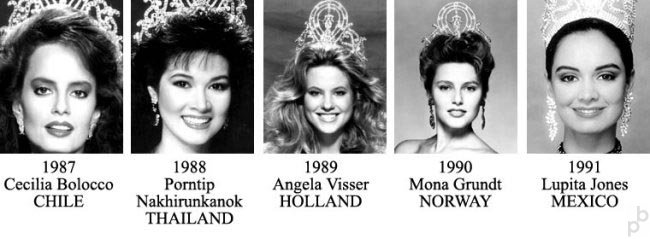
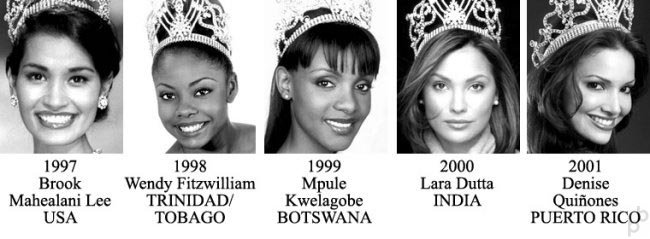
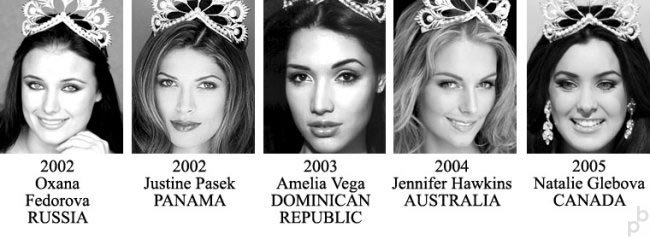
HISTORY : Miss Universe TitleHolders
Posted by
ա!Ⓛⓛ !ʍƥŐṥʂ!βⓁǝ
[Right click on images 'open new window' to enlarge]
Miss Universe
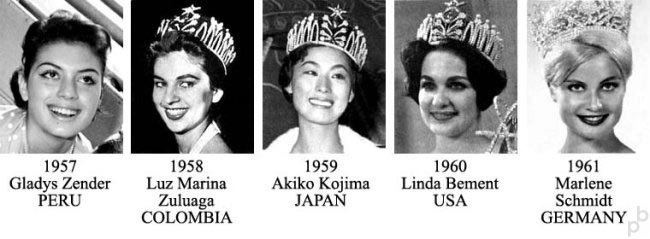
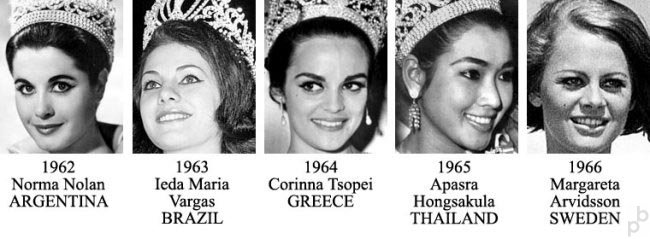
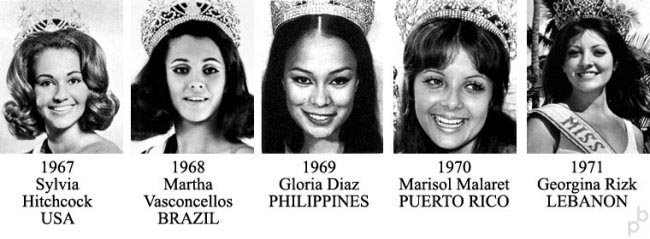
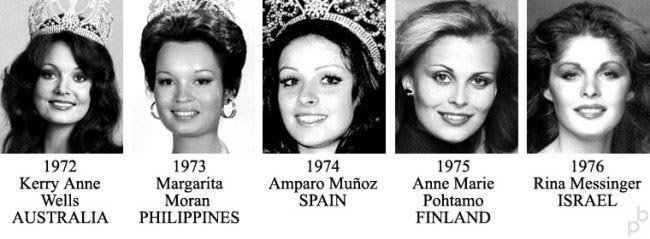
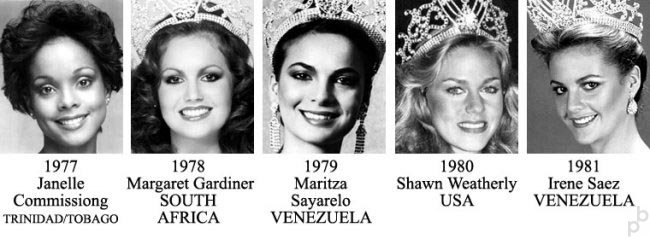
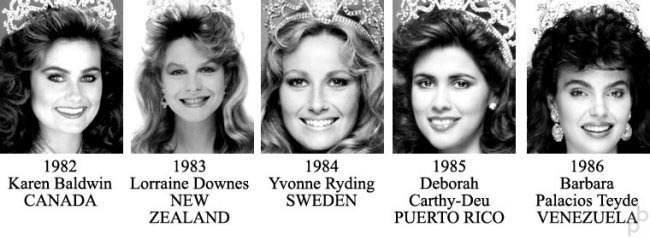
Miss Universe is an annual international beauty contest, and the title for the winner of the contest, founded in 1952 by California clothing company Pacific Mills. The pageant became part of Kayser-Roth and then Gulf and Western Industries, before being acquired by Donald Trump in 1996. Despite its historical rivalry with the Miss World contest, Miss Universe retains unparalleled prestige in many parts of the world, particularly Asia and Latin America[citation needed]. The reigning Miss Universe is Zuleyka Jerris Rivera Mendoza, representing Puerto Rico. This event is sometimes referred to as the World Cup of Beauty.
History
The winner of 1950's "Miss America 1951" pageant, Yolande Betbeze, refused to pose in a swimsuit from major sponsor Catalina swimwear. As a result, the brand's manufacturer Pacific Mills withdrew from Miss America and set up the Miss USA and Miss Universe contests. The first Miss Universe Pageant was held in Long Beach, California in 1952. It was won by Armi Kuusela from Finland, who gave up her title to get married to a Filipino tycoon, Virgilio Hilario, shortly before her year was complete. Until 1958 the Miss Universe title (like Miss America) was post-dated, so at the time Ms. Kuusela's title was Miss Universe 1953.
The pageant was first televised in 1955. CBS began nationally broadcasting the Miss USA and Miss Universe pageants combined from 1960, and separately from 1965. In 2003, NBC took over the television rights.
The main pageant was held in the United States until 1972, when it was held in Dorado, Puerto Rico. Since then it has usually been held in a different city each year, though Manila, Los Angeles, Las Vegas, Bangkok, and Panama City have each hosted it twice.
The Crown
Design by Mikimoto. The official jewelry sponsor of the Miss Universe Organization.[1] Kept by the Miss Universe Organization to be used in the crowning of the new Miss Universe every year. Valued at $250,000. 800 diamonds, almost 18 carats. 120 pearls South Sea and Akoya pearls, ranging in size from 3.0 - 18 mm. Design depicts the phoenix rising, which signifies status, power and beauty. The Crown was designed specifically for the pageant on Mikimoto Pearl Island in Japan, Mikimoto crown and tiara first used for Miss Universe 2002.
Miss Universe 2006
The 2006 Miss Universe Pageant took place in Los Angeles, California on Sunday, July 23rd in the Shrine Auditorium. This was the first time since 1998 that the pageant was held in the United States and it was also the second time to have been held in Los Angeles.
Puerto Rico's Zuleyka Jerris Rivera Mendoza won the crown.
The first runner-up was Japan's Kurara Chibana, followed by Switzerland's Lauriane Gillieron. The third runner-up was Paraguay's Lourdes Arevalos and the fourth runner-up was USA's Tara Conner.
Miss Philippines, Lia Andrea Ramos, was chosen as Miss Photogenic; Japan's Kurara Chibana as Best National Costume; and Ghana's Angela Asare as Miss Congeniality.
Wednesday
HISTORY OF NECKWEAR (Tie)
Posted by
ա!Ⓛⓛ !ʍƥŐṥʂ!βⓁǝ
The history of neckties dates back a mere hundred years or so, for they came into existence as the direct result of a war. In 1660, in celebration of its hard-fought victory over the Ottoman Empire , a crack regiment from Croatia (then part of the Austro-Hungarian Empire), visited Paris. There, the soldiers were presented as glorious heroes to Louis XIV, a monarch well known for his eye toward personal adornment. It so happened that the officers of this regiment were wearing brightly colored handkerchiefs fashioned of silk around their necks. These neck cloths, which probably descended from the Roman fascalia worn by orators to warm the vocal chords, struck the fancy of the king, and he soon made them an insignia of royalty as he created a regiment of Royal Cravattes. The word "cravat," incidentally, is derived from the word "Croat."
It wasn't long before this new style crossed the channel to England. Soon no gentleman would have considered himself well-dressed without sporting some sort of cloth around his neck--the more decorative, the better. At times, cravats were worn so high that a man could not move his head without turning his whole body. There were even reports of cravats worn so thick that they stopped sword thrusts. The various styles knew no bounds, as cravats of tasseled strings, plaid scarves, tufts and bows of ribbon, lace, and embroidered linen all had their staunch adherents. Nearly one hundred different knots were recognized, and as a certain M. Le Blanc, who instructed men in the fine and sometimes complex art of tying a tie, noted, "The grossest insult that can be offered to a man comme il faut is to seize him by the cravat; in this place blood only can wash out the stain upon the honor of either party."
In this country, ties were also an integral part of a man's wardrobe. However, until the time of the Civil War, most ties were imported from the Continent. Gradually, though, the industry gained ground, to the point that at the beginning of the twentieth century, American neckwear finally began to rival that of Europe, despite the fact that European fabrics were still being heavily imported.
In the 1960s, in the midst of the Peacock Revolution, there was a definite lapse in the inclination of men to wear ties, as a result of the rebellion against both tradition and the formality of dress. But by the mid-1970s, this trend had reversed itself to the point where now, in the 1990s, the sale of neckwear is probably as strong if not stronger than it has ever been.
How to account for the continued popularity of neckties? For years, fashion historians and sociologists predicted their demise--the one element of a man's attire with no obvious function. Perhaps they are merely part of an inherited tradition. As long as world and business leaders continue to wear ties, the young executives will follow suit and ties will remain a key to the boardroom. On the other hand, there does seem to be some aesthetic value in wearing a tie. In addition to covering the buttons of the shirt and giving emphasis to the verticality of a man's body (in much the same way that the buttons on a military uniform do), it adds a sense of luxury and richness, color and texture, to the austerity of the dress shirt and business suit.
Perhaps no other item of a man's wardrobe has altered its shape so often as the tie. It seems that the first question fashion writers always ask is, "Will men's ties be wider or narrower this year?"
In the late 1960s and early 70s, ties grew to five inches in width. At the time, the rationale was that these wide ties were in proportion to the wider jacket lapels and longer shirt collars. This was the correct approach, since these elements should always be in balance. But once these exaggerated proportions were discarded, fat ties became another victim of fashion.
The proper width of a tie, and one that will never be out of style, is 3-1/4 inches (2-3/4 to 3-1/2 inches are also acceptable). As long as the proportions of men's clothing remain true to a man's body shape, this width will set the proper balance. Though many of the neckties sold today are cut in these widths, the section of the tie where the knot is made has remained thick--a holdover from the fat, napkin-like ties of the 1960s. This makes tying a small, elegant knot more difficult. Yet the relationship of a tie's knot to the shirt collar is an important consideration. If the relationship is proper, the knot will never be so large that it spreads the collar or forces it open, nor will it be so small that it will become lost in the collar.
Standard neckties come in lengths anywhere from 52 to 58 inches long. Taller men, or those who use a Windsor knot, may require a longer tie, which can be special-ordered. After being tied, the tips of the necktie should be long enough to reach the waistband of the trousers. (The ends of the tie should either be equal, or the smaller one just a fraction shorter.)
After you've confirmed the appropriateness of a tie's shape, next feel the fabric. If it's made of silk and it feels rough to the touch, then the silk is of an inferior quality. Silk that is not supple is very much like hair that's been dyed too often. It's brittle and its ends will fray easily. If care hasn't been taken in the inspection of ties, you may find misweaves and puckers.
All fine ties are cut on the bias, which means they have been cut across the fabric. This allows them to fall straight after the knot has been tied, without curling. A simple test consists of holding a tie across you hand. If it begins to twirl in the air, it was probably not cut on the bias and it should not be purchased.
Quality neckties want you to see everything: they have nothing to hide. Originally, neckties were cut from a single large square of silk, which was then folded seven times in order to give the tie a rich fullness. Today the price of silk and the lack of skilled artisans prohibits this form of manufacture. Ties now derive their body and fullness by means of an additional inner lining.
Besides giving body to the tie, the lining helps the tie hold its shape. The finest-quality ties today are lined with 100 percent wool and are generally made only in Europe. Most other quality ties use a wool mixture. The finer the tie, the higher the wool content. You can actually check. Fine linings are marked with a series of gold bars which are visible if you open up the back of the tie. The more bars, the heavier the lining. Many people assume that a quality tie must be thick, as this would suggest that the silk is heavy and therefore expensive. In fact, in most cases it is simply the insertion of a heavier lining that gives the tie this bulk. Be sure, then, that the bulk of the tie that you're feeling is the silk outer fabric and not the lining.
After you've examined the lining, take a look at the tie just above the spot where the two sides come together to form an inverted V. In most quality ties, you will find a stitch joining the back flaps. This is called the bar tack, and it helps maintain the shape of the tie.
Now, if you can, open up the tie as far as possible and look for a loose black thread. This thread is called the slip stitch and was invented by a man named Joss Langsdorf in the 1920s to give added resilience to the tie. The fact that the tie can move along this thread means that it won't rip when it's being wrapped tightly around your neck, and that it will, when removed, return to its original shape. Pull the slip stitch, and the tie should gather. If you can do this, you've found a quality, handmade tie.
Finally, take the tie in your hand and run your finger down its length. You should find three separate pieces of fabric stitched together, not two, as in most commercial ties. This construction is used to help the tie conform easily to the neck.
Tuesday
From Humble Beginnings
Posted by
ա!Ⓛⓛ !ʍƥŐṥʂ!βⓁǝ
The Inaugural Meeting of the Lodge was held in the Masonic Hall, Ipswich, on February 19th, 1866 as Caledonian Lodge No.456 S.C.
This two-storied brick hall, situated on the corner of Brisbane and Thorn Streets was the property of Queensland Lodge No.921 E.C. (now No.2 U.G.L.Q.), and it is reputed to be the first Masonic Hall built in Queensland. Therein met, John Kennedy Donald, 1st. Wor. Master; James C. Moffatt, 1st. Senior Warden; and William Duesberry, 1st. Junior Warden, together with Bros. Patrick Clarke, Abraham Fitzgibbon, Alexander G. Gilmour, John MacDonald, jnr., Thomas Hamilton, James A. Rath, Adam Robb Moffatt, David Rodger, Henry Dawe and Alexander Hutchinson. These, with Bro. J. Pimm, Tyler already to Queensland Lodge, The Earl of Mornington Lodge and United Tradesmen's Lodge, constituted the first fourteen Members of Caledonian Lodge; surely a prophetic number.
Some thirty odd visitors signed the Attendance Roll Book, including: W.M. Boyce, Deputy Provincial Grand Master of the English Constitution and a Member of North Australian Lodge No. 1098; the Wor. Master H.V. Hassell and several Brothers of Queensland Lodge No.921 E.C.; the Wor. Master J. Robinson and Brothers of United Tradesman Lodge No.217 I.C.; and a number of Brethren from Earl of Mornington Lodge No.208 I.C.; St. Patrick's of Cork No.8 I.C.; and Courage with Humanity No.557.
The local newpaper in Ipswich, the "Queensland Times" reported of the meeting on February 20th, 1866, which read:-
About fifty brethren of the Masonic Order assembled at the Masonic Hall last evening, on the occasion of the opening of a new Lodge, called the Caledonian, holding of the Grand Lodge of Scotland. Lodge having been opened in the usual form, authority was read from the Provincial Grand Master of Victoria, empowering Bro. A.G.Gilmour, Past Master of Glasgow Kilwinning Lodge (Scotland) to open and consecrate the new Lodge.
The O.B., having delivered a charge, called upon the Secretary to read a temporary Charter from the Prov. Grand Lodge of Victoria, appointing Bro. John Kennedy Donald the First Master; P. Clark, Deputy Master; J.C. Moffatt, S.W.; W. Duesberry, J.W.; J. McDonald, Jnr., Treasurer; T. Hamilton, Secretary; J.A. Rath, S.D.; A.R. Moffatt, J.D.; D. Rodgers, I.G., and H. Dawe, O.G. The Presiding Officer then delivered an Oration on Masonry, and, an anthem having been sung by the Brethren, the Jewels of the Lodge were delivered to the Presiding Officer and the W.M. elect and office-bearers were introduced. The consecrating elements - corn, wine and oil - were then presented and sprinkled, and after prayer by the officiating Chaplain, another anthem was sung by the Brethren. To the sound of solemn music the Members of the new Lodge afterwards passed round and saluted the O.B. Verses from scripture were read by the Chaplain and, anthem having been sung, the new Lodge was declared duly consecrated.
The Presiding Officer next proceeded with the Installation of the various officers as directed by the Warrant of Constitution, and the ceremony concluded with the singing of a Masonic Anthem. The Brethren afterwards sat down to a banquet prepared by Bro. Wright and the usual loyal and Masonic toasts were given and replied to.
Bro. Montague Younger presided at the harmonium and his performance added greatly to the solemn effect of the ceremonial.
Bro. W.M. Boyce, Deputy Prov. Grand Master of the English Constitution, also assisted, and we hear that he is also Prov. Grand Master under the Scottish Constitution.

The fees of the day were seven Guineas for Initiation and a further two Pounds for annual dues; roughly equating to $277 in todays money.
The lodge moved several times between 1866 and 1928, when, on December 8th, a combined meeting of the local Lodges was held for the Dedication of the New Temple by the Grand Master, Most Wor. Bro. Charles Stumm at the current location at Nicholas Street.
Caledonian also had several numbers on the roll. With the formation of Queensland Grand Lodge in 1920, No.456 was replaced with No.8. A year later, the Queensland Grand Lodge unified with Grand Lodge of Queensland to form the United Grand Lodge of Queensland under which Caledonian was designated No.14 U.G.L.Q.
Monday
The Caly Tartan
Posted by
ա!Ⓛⓛ !ʍƥŐṥʂ!βⓁǝ

The origin of when and how Caledonian Lodge came to adopt the Royal Stewart tartan is difficult to determine. The records of history do elude to the fact that from the granting of our Charter in 1866, our original regalia colour was listed as "Tartan".
Somewhere along the line we adopted the Blue that many lodges commonly wear today but in March of 1888 it was decided to drop the Blue and adopt a Maroon coloured apron. A photograph of the Brethren in 1926 (our 60th anniversary) shows what looks to be light blue regalia. Admittedly, it is a black and white photograph, but the tartan pattern is definitely not present nor does it look dark enough to be Maroon.
During the post World War II years it became difficult to obtain new Master Masons aprons owing to the impossibility of procuring the required materials to make them and many weird and wonderful substitutes had been seen in the various Lodges. In February, 1947, orders were again being taken for M.M. aprons, but there was a considerable waiting list.
An order was placed for a complete set of aprons and collars for the Lodge Officers and Past Masters in November, 1952 due to the state of the ones in use at that time. Orders had also been placed for new covers for the Altar, the three principal pedestals and the Chaplain’s lectern. It would be assumed that these were tartan in colour as another photograph of the Brethren in 1966 (100th anniversary) shows them wearing the Royal Stewart regalia.

The tartan bow tie was being worn by 1991 if not sooner but seems to have been well before the formal request and approval was granted, for it wasn't until March, 1996 that correspondence from Grand Lodge affirmed for dispensation from the Grand Master to wear our “Tartan” Bow Tie.
The Royal Stewart Tartan itself is the personal tartan of Queen Elizabeth II and it is said to be appropriate for all subjects of English Monarchy to wear the tartan. Officially, the tartan is worn by numerous military groups, and a select few civilian groups.
Perhaps it was their loyalty to the Royal family or the fact the Lodge had a long history with the local military at RAAF Amberley that influenced their decision to select the Royal Stewart as theirs to prouldly wear or perhaps it was the more romantic notion that it represented Scotland like no other tartan can. Whatever it was, it means a great deal to the Caledonian Brethren and we wear it today with the honour and respect that it fully deserves.
Subscribe to:
Posts (Atom)